By Jeff Smith
As we look around at today’s America, it’s clear that creating cohesive community is complicated and seems to be getting more complicated and messy with each passing year. Lancaster, Pennsylvania, as an iconic home of Amish and Mennonite faiths, is a natural place to contemplate cohesive community, because these faiths have made community a central part of their belief system, a central pillar of their resilience, for 500 years. What can we in broader America learn from their experience, from their success?
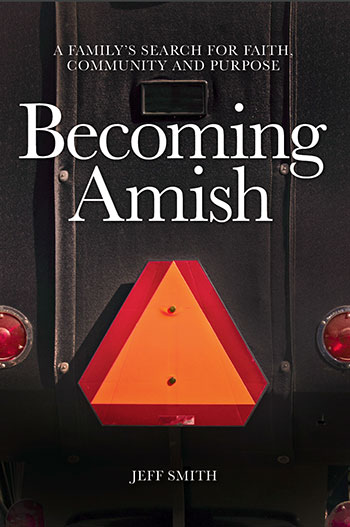 That question has been on my mind a lot recently because not long ago I completed a book, titled “Becoming Amish,” about a family I know that was living a striver life in one of America’s wealthiest communities when they began a journey of faith that led them to join an Old Order Amish church. Finding a community of shared faith was an important part of what they sought.
Bill and Tricia Moser, the couple whose journey I wrote about, did find a powerful sense of community with the Amish, living within a shared belief system, a shared value system. They found remarkable support in starting businesses, in learning the skills for Amish life—how to garden, how to can, how to sew, how to manage horses. They found great spiritual strength in the embrace of brotherhood and sisterhood expressed in their churches.
But the Mosers also found that keeping cohesive community was never an easy thing, even with all the Amish rules of behavior and cultural emphasis. Church members had to work at it. An example: when church members evaluate new technologies for acceptance or rejection, they discuss how family and community cohesion will be affected. Will a hay baler that allows one man to do the work weaken community because he no longer needs friends to help? Will allowing propane lights in bedrooms rather than just the living room and kitchen weaken families because kids can go read alone in their bedrooms rather than staying together reading in the living room?
The Amish take communion twice a year. In the weeks leading up to communion, church members bring up points of conflict between neighbors and within families. Clergy work to resolve those conflicts. If the conflicts are not adequately resolved, the community does not perform its communion rituals. An Amish church typically has 20 to 30 families—the size of a city block. Imagine if this level of conflict resolution were happening in general society!
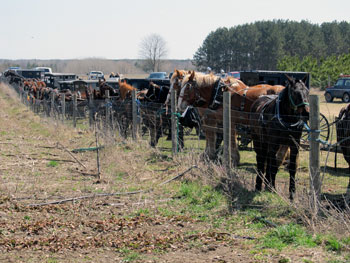 The Mosers also discovered that the Amish live life in such a deeply human way, at such a connected level, and that this was also an essential part of Amish community strength. They learned that visiting is what the Amish do for entertainment. They sit with one another, they tell stories, they share meals, they sing songs. When the Amish go on vacation, Bill told me, they don’t even call it vacation, they call it “going visiting,” and they travel the nation stopping in to see friends. So beyond the strict rules of Amish life and their emphasis on preserving community relationships, there is a broad and deep cultural value placed on simply getting to know one another, being present in one another’s company. Each connection a thin thread, but when woven together and laid one over the other, it creates a strong and resilient web—one that has endured five centuries.
And, yes, the Amish are imperfectly human, too. Despite the rules, interventions, and gathering, it is not all that uncommon for a member to object to one rule or another and move to a community with slightly different rules that fit his or her views of the faith.
At one point I was interviewing a respected Amish bishop about the biggest problems average Americans face when entering the Amish faith, and he immediately pointed to the reverence for strong individuality that is so amplified in American culture and mass media. The “don’t tread on me” mentality, the push to fulfill our individual destiny and not let others stand in the way, it can seem at odds with building community, which takes giving ground, adhering to the broader community’s rules. Sometimes it seems the nation’s celebration of individuality has been taken to such extremes it is nearly a caricature of the idea, and it has made us blind to a great and powerful truth that is right in front of us every single day: we are a tribal/community species and have been forever and will always be. Our ships rise when the tide of community rises.
 But here’s an important thing: being part of community does not mean trading away your individuality. The Amish I met while delving into Bill and Tricia’s journey were strong as individuals and strong as community members. American mass culture keeps trying to convince us that if we free up individuals to fully live out an unfettered individuality, then strong communities will rise in their wake. The Amish turn that idea on its head: work intentionally to create strong communities and they will give rise to strong individuals, like strong crops rising from well-tended soil.
Of course, unlike the Amish, America does not share one faith, it does not share one culture, it does not share one ethnicity. Our challenge is to create strong community in a diverse and evolving culture—that’s more difficult! But we can borrow and learn from the Amish experience. First, we can fully acknowledge, open our eyes to, the power and potential of strong community and its role in creating strong individuals. We can embrace the Amish’s deep sense of humanity, emulate their strong support for one another, we can increase the time we spend visiting with one another, and we can be intentional about creating the communities we want to see.
Jeff Smith is a career journalist and author of Becoming Amish.