

The Amish Story Begins 500 Years Before Lancaster
The Amish are descendants of the Anabaptists, a group that arose during the Protestant Reformation in 16th-century Europe. They split from the Mennonites in 1693 under the leadership of Jacob Ammann, who called for stricter practice of shunning. Seeking religious freedom, Amish families began arriving in Pennsylvania in the 1720s and 1730s, drawn by William Penn’s welcome, and Lancaster County became one of the largest Amish settlements in North America.
Menno Simons and the Mennonites
In 1536, a young Catholic priest from Holland named Menno Simons joined the Anabaptist movement. His writings and leadership united many of the Anabaptist groups, who later became known as “Mennonites.”
The 1693 Split: Jacob Ammann and Shunning
One of the teachings of the Amish faith is called the ban or shunning. This is based on the New Testament command not to associate with a church member who does not repent of his sinful conduct. The purpose of this discipline is to help the member realize the error of his ways and to encourage his repentance, after which he would be restored to church fellowship.
This excommunication was at first only applied at the communion table. However, the followers of Jacob Amman felt the unrepentant individual should be completely shunned or avoided by all church members. This belief, along with other differences, led to Amman’s split with the Mennonites in 1693.
Where do the Amish get their name?
Jacob Ammann’s followers were later called “Amish“.
Persecution and Flight to the Mountains
These Anabaptist groups were severely persecuted throughout Europe. Thousands were put to death as heretics by both Catholics and Protestants. To avoid this persecution, many fled to the mountains of Switzerland and southern Germany. Here began the Amish tradition of farming and holding their worship services in homes rather than churches.
Why the Amish Came to Lancaster County
Many Amish and Mennonites accepted William Penn’s offer of religious freedom as part of Penn’s “holy experiment” of religious tolerance. They settled in what later became known as Pennsylvania. The first sizable group of Amish arrived in Lancaster County in the 1720s or 1730s.
The Amish Today
Today, the Amish can be found in 23 states here and in one Canadian province. Their settlement in and around Lancaster County is their second largest. Because of their large families, the total Amish population has more than doubled since 1960 to over 85,000. Very few of their children leave the church.
Amish vs Mennonite: What’s the Difference?
Amish and Mennonites share the same roots and core beliefs on adult baptism, nonresistance, and the Bible. The Amish are more conservative in dress, technology, and worship, and the Mennonites are generally less so.
The Mennonites hold many of the same beliefs as the Amish, although they tend to be less conservative than their Amish neighbors. Worship services are held weekly in their meeting houses. Most Mennonites have relaxed dress codes, and have gotten away from farm-related occupations. While Old Order Mennonites still drive their all-black carriages, most Mennonite groups do permit the use of cars and electricity. However, some groups do require that car bodies and trim be painted black.
Explore Amish Attractions
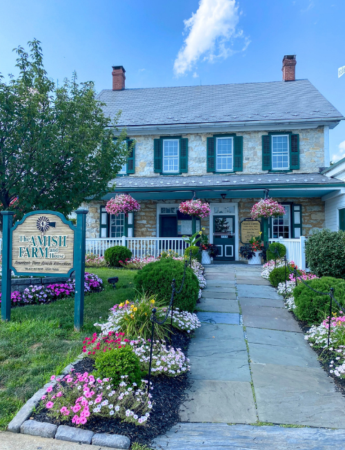
To see this history come alive, visit an Amish farm and house, take a buggy ride, or tour the Mennonite Information Center. For more on Amish life, read about Amish beliefs and our Amish FAQ.
Keep Exploring Lancaster County







Plan Your Visit